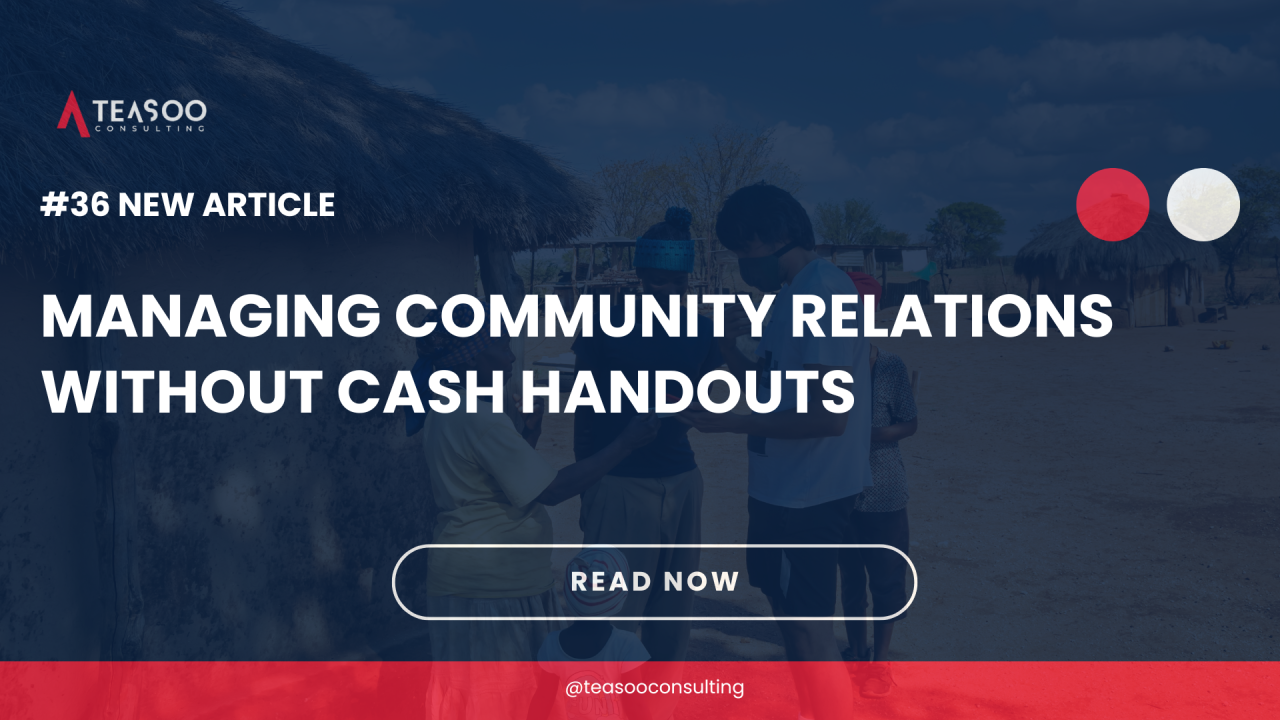
For decades, many organizations operating in complex environments relied on “cash for peace”, a model of direct payouts to local leaders to ensure operational stability. However, industry experts now agree that this transactional approach is not only unsustainable but often fuels the very conflict it seeks to prevent. True “Social License” is not a commodity to be purchased; it is an asset to be earned through transparent engagement and shared prosperity.
Key Takeaways:
- Why the handout model fails: Direct cash payments often lead to internal community conflict and a cycle of dependency.
- Defining Social License: Understanding that community acceptance is an intangible asset that requires constant maintenance.
- The power of Shared Value: Shifting from philanthropy to strategic investments that benefit both the business and the community.
- Practical Frameworks: How to implement Community Development Agreements (CDAs) to formalize trust.
The breaking point of the “cash for peace” model
The traditional approach to community relations has long been reactive, often involving “envelope diplomacy” where funds are distributed to silence dissent. While this might offer a temporary reprieve, it rarely addresses the root causes of community dissatisfaction or poverty. In fact, research suggests that direct payouts can inadvertently fund local power struggles, leading to more frequent disruptions as different factions vie for control over the funds.
“The fundamental flaw of the handout model is that it creates a rent-seeking relationship rather than a partnership,” says Sarah Esangbedo, a Senior Sustainability Consultant with over 20 years of experience in extractive industries. “When the cash stops or the amount decreases, the relationship collapses because there was never any foundational trust or mutual benefit.”
The financial stakes of failing to manage these relations are immense. According to a landmark study by the Harvard Kennedy School, a major mining project can lose approximately $20 million to $30 million per week in net present value due to community-related delays. These statistics highlight that community relations is no longer a “soft” issue, but a core financial risk that requires a strategic, non-monetary approach.
Understanding the Social License to Operate
To move beyond handouts, organizations must first master the concept of the Social License to Operate (SLO). An SLO is an unwritten, informal agreement where a community grants a company the “permission” to exist and operate in their backyard. Unlike a legal permit issued by a government, a social license is granted by stakeholders and can be withdrawn at any moment if trust is breached.
Building this license requires a transition from being a “benefactor” to being a “neighbor.” This shift involves moving away from the idea that the community is a problem to be managed and toward the idea that they are a partner in the project’s success. Have you ever wondered why some companies face constant protests while others in the same region operate peacefully? The difference almost always lies in the quality of their engagement, not the size of their checkbook.
The International Council on Mining and Metals (ICMM) emphasizes that a social license is built on three pillars: legitimacy, credibility, and trust. If a community perceives that a company is only paying them to stay quiet, credibility remains low. However, when a company invests in projects that improve local livelihoods, they demonstrate a commitment to the community’s long-term future.
The shift from philanthropy to Shared Value
If cash isn’t the answer, what is? The answer lies in Shared Value, a management strategy in which companies find business opportunities in addressing social problems. Instead of writing a check to a local leader, a company might invest in a vocational training center that prepares local youth for jobs within the company’s own supply chain.
This approach transforms the community from passive recipients of charity into active participants in the local economy. For example, the International Finance Corporation (IFC) reports that companies that prioritize local procurement, buying goods and services from local businesses, see a significant decrease in operational disruptions. By integrating the community into the business ecosystem, the community’s success becomes tied to the company’s success.
“Shared value is not about ‘sharing’ the value already created through redistribution,” explains Michael Porter, a leading authority on competitive strategy at Harvard Business School. “It is about expanding the total pool of economic and social value.” When a community sees tangible improvements in infrastructure, healthcare, and employment, their incentive to protect the company’s operations increases exponentially.
The role of transparent agreements and CDAs
One of the most effective ways to build trust without handouts is through the implementation of Community Development Agreements (CDAs). A CDA is a formal, legally binding contract between a company and a community that outlines exactly what the community can expect in terms of benefits, and what the company expects in terms of operational stability.
Transparency is the vital ingredient here. When agreements are made behind closed doors with a few select individuals, the rest of the community often feels cheated. Publicly disclosed CDAs ensure that everyone knows where the resources are going and how they are being managed. This prevents the “information asymmetry” that often leads to rumors and unrest.
According to data from the World Bank, projects that utilize multi-stakeholder oversight committees to manage community funds see a 40% higher rate of project completion compared to those where funds are managed solely by local elites. This collective oversight ensures that resources are used for their intended purpose, such as building a new school or improving irrigation systems, rather than disappearing into private pockets.
How to get started: Building a sustainable framework
Transitioning away from a handout-based model is a marathon, not a sprint. It requires a fundamental change in corporate culture and a commitment to long-term engagement. If you are ready to move toward a more sustainable model of community relations, here is how you can begin:
- Conduct a Social Mapping Exercise: Identify the real influencers in the community, not just the loudest voices or official leaders. Understand the internal power dynamics and historical grievances.
- Perform a Baseline Needs Assessment: Work with the community to identify what they actually need. Do not assume that a new community center is more valuable than a clean water source or a paved road.
- Establish Multi-Stakeholder Committees: Create a forum where company representatives, local government, and community members can meet regularly to discuss progress and resolve conflicts.
- Prioritize Local Procurement and Employment: Set measurable targets for hiring locally and sourcing materials from local vendors. This is the most direct way to create “shared value.”
- Audit and Report Transparently: Regularly publish reports on the status of community projects. Use independent third parties to verify that commitments are being met.
The bottom line: Get moving. The longer an organization relies on handouts, the harder it becomes to break the cycle of dependency.
Conclusion: Trust is the ultimate currency
Moving beyond cash handouts is a fundamental business necessity in the modern ESG landscape. By prioritizing shared value and transparency, companies build trust that survives long after the initial investment phase. Teasoo Consulting has extensive experience helping organizations navigate these complex social dynamics and transition toward sustainable community partnerships. If your organization is ready to secure its social license and build lasting local stability, contact the experts at Teasoo Consulting today to learn how our tailored strategies can transform your community relations.