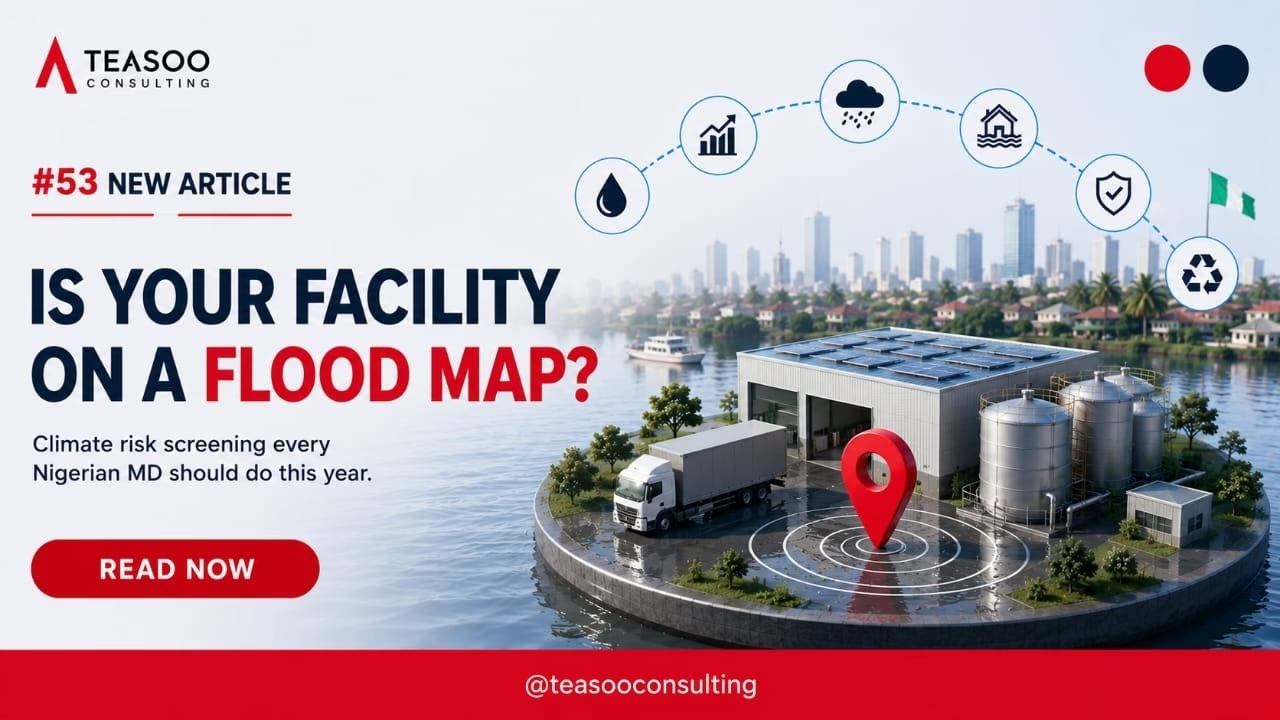
Climate risk screening every Nigerian MD should do this year.
By Sarah Ajose-Adeogun (MCIPM, M.CIoD, FIMC) Managing Partner, Teasoo Consulting Limited
As torrential rains battered Lagos and Accra over the past two weeks, the headlines focused on flooded roads, submerged homes, displaced families and tragic loss of lives. Less visible, however, was another casualty; Business Continuity.
Factories suspended operations. Offices closed. Employees were stranded. Supply chains were disrupted. Retail businesses lost sales. Warehouses suffered water damage. For many organisations, what appeared to be another seasonal flood quickly became a significant operational and financial risk.
The lesson is clear: climate risk is no longer a future concern. It is today’s business reality.
Yet, despite increasing climate-related disasters, many Business Continuity Plans (BCPs) still assume that tomorrow’s floods will resemble yesterday’s. They rarely incorporate climate-adjusted flood projections or geospatial risk analysis.
That is a costly oversight.
Recent assessments indicate that more than 50 Local Government Areas across Nigeria face severe flood risk, with several states expected to experience above-normal flooding during this year’s rainy season. Combined with rapid urbanisation, blocked drainage systems and changing rainfall patterns, the exposure of businesses continues to increase.
The question every Managing Director should be asking is simple:
Do we know whether our facilities are located in a flood-prone area?
If the answer is no, the good news is that your organisation can conduct an initial climate risk screen at little or no cost.
Climate Intelligence Has Become a Boardroom Issue
Climate resilience is no longer just the responsibility of HSE or Sustainability teams.
It is now a strategic business issue affecting operations, finance, insurance, investment decisions and corporate governance.
A flooded warehouse is no longer merely an environmental incident; it can trigger inventory losses, production delays, contractual penalties, higher insurance costs, reputational damage and significant business interruption.
This is precisely why global sustainability standards such as IFRS S2 require organisations to identify, assess and disclose material physical climate risks.
Boards can no longer afford to manage climate risks using historical assumptions alone.
Five Free Tools Every Organisation Should Know
One of the biggest misconceptions is that climate risk assessment is expensive.
While detailed engineering studies remain important, every organisation can begin with publicly available geospatial data.
Some useful resources include:
- Google Earth – Locate and map every operational facility.
- OpenStreetMap – Understand surrounding infrastructure, waterways and drainage.
- NASA EarthData – Access satellite imagery and rainfall datasets.
- Copernicus Emergency Management Service – Monitor flood and land-use information.
- Global Flood Awareness System (GloFAS) – Review flood forecasts and river conditions.
Combined, these tools provide valuable first-level insights into potential flood exposure and can help prioritise sites requiring detailed assessment.
Six Questions Every Board Should Ask
As the rainy season intensifies, leadership teams should ask:
- Which of our facilities lie within flood-prone zones?
- Which critical suppliers face similar exposure?
- Have we assessed the financial impact of a seven-day operational shutdown?
- Are our backup generators, data centres and critical assets themselves flood protected?
- Have evacuation and emergency response procedures been tested recently?
- Does our Business Continuity Plan reflect current climate projections rather than historical flood records?
If these questions cannot be answered with confidence, your organisation may already have an unmanaged climate risk.
Teasoo ESG Insight
Climate resilience begins with understanding where your assets are located.
Every organisation should conduct an annual Flood Risk Screening Exercise by:
- Mapping all operational facilities using GPS coordinates.
- Overlaying facility locations with publicly available flood-risk and elevation maps.
- Identifying critical suppliers located in high-risk areas.
- Updating Business Continuity Plans using climate-adjusted flood scenarios.
- Reporting physical climate risks to the Board as part of enterprise risk management.
This exercise can often be completed within a few hours and may prevent losses running into millions of naira.
Final Thoughts
The organisations that will thrive in a changing climate will not necessarily be those with the largest balance sheets.
They will be the ones that use data to anticipate risk before disaster strikes.
Climate resilience is no longer about reacting after a flood.
It is about knowing before the rains begin, whether your business is standing on safe ground.
At Teasoo Consulting, we believe better climate decisions begin with better climate data.
Because in today’s business environment, every facility should first be located on a flood map before it is included in a business continuity plan.