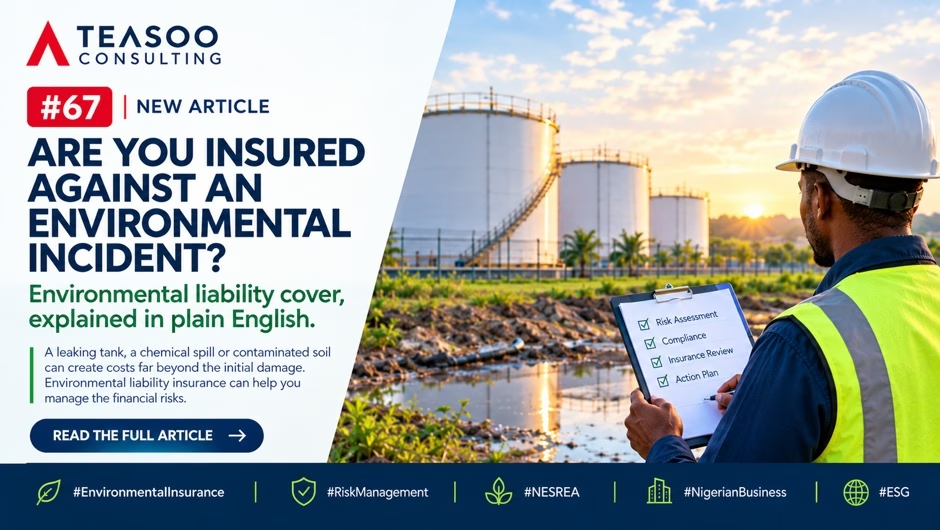
Environmental liability cover, explained in plain English
Drop a water sachet on a Nigerian street and you can be fined up to ₦20,000, jailed for up to six months, or both.
Now imagine a diesel tank leaking into the soil behind your facility.
If dropping a sachet carries a penalty, think about what a spill could cost. Cleanup orders can run into very significant sums, and most businesses never planned for that bill.
Would your current insurance cover those costs?
Many businesses may not know the answer until an incident occurs. Understanding environmental liability insurance can help you identify potential gaps before they become costly problems.
First, who is NESREA?
The National Environmental Standards and Regulations Enforcement Agency (NESREA) is Nigeria’s federal environmental enforcement agency. It enforces applicable environmental standards and regulations and can take action against activities that breach requirements within its statutory mandate.
Environmental regulation in Nigeria is shared across different authorities. Oil and gas operations, for example, are subject to sector-specific regulatory frameworks, although responsibilities depend on the activity and applicable law.
For businesses in manufacturing, agriculture, construction, hospitality, healthcare and warehousing, understanding the environmental requirements that apply to their operations is an important part of managing risk.
“But my insurance covers me, right?”
Not necessarily.
Many businesses carry Commercial General Liability (CGL) insurance, which can cover certain third-party bodily injury and property damage claims arising from business operations.
However, many standard CGL policies contain pollution exclusions. The wording and exceptions vary, so businesses should not assume their existing policies cover environmental incidents.
Consider a factory where a chemical leak contaminates neighbouring land. The costs of investigating and cleaning up the contamination may fall outside its general liability cover.
One option worth discussing with a qualified insurance broker is Environmental Liability Insurance, also known in some markets as Environmental Impairment Liability or Pollution Legal Liability (PLL).
Specialist pollution-related cover may be available for qualifying risks, depending on the insurer and market. Nigerian businesses should confirm local availability, underwriting requirements and policy terms with a licensed insurer or broker.
What can environmental liability insurance cover?
Depending on the policy, potential areas of cover include:
- Cleanup and remediation: Eligible costs of investigating and cleaning up contamination affecting soil or water.
- Third-party claims: Certain claims for bodily injury or property damage affecting neighbouring landowners, businesses or communities.
- Legal defence: Eligible legal expenses arising from covered claims.
- Business interruption: Losses resulting from operational disruption, where expressly covered.
Policies may cover a particular site, contractors’ activities or a wider portfolio of environmental exposures.
However, these protections are not automatic. Always check the policy limits, exclusions, deductibles and conditions.
One important term: claims-made cover.
Some policies require a claim to be made during the applicable policy period. Retroactive dates, notification requirements and extended reporting provisions can also affect protection. Allowing a policy to lapse or changing insurers without reviewing these conditions could leave gaps in cover.
What might not be covered?
Environmental liability insurance does not cover every environmental loss. Depending on the policy, exclusions may apply to:
- Regulatory fines and penalties: These are commonly excluded.
- Pre-existing contamination: Historical or known contamination may be excluded or subject to specific conditions.
- Deliberate misconduct: Intentional pollution and certain forms of deliberate non-compliance may be excluded.
- Uninsured losses: Deductibles, costs exceeding policy limits and activities outside the insured scope may remain the business’s responsibility.
The lesson is simple: understand the policy before an incident occurs.
Insurance can help transfer certain financial risks, but it cannot eliminate environmental risks or a business’s legal responsibilities.
Why should Nigerian businesses pay attention?
Environmental incidents can affect operations, neighbouring communities, supply chains and local ecosystems. Their financial consequences may extend well beyond the immediate damage.
Nigeria’s 2012 floods illustrate the potential scale of environmental and climate-related losses. The country’s Post-Disaster Needs Assessment estimated combined damages and economic losses at approximately US$16.9 billion.
Flood damage and pollution liability are different risks, but both demonstrate why businesses need to understand their exposure and prepare for events that could disrupt operations.
The insurance sector is also paying greater attention to sustainability and climate-related risks. In April 2026, the National Insurance Commission (NAICOM) announced ongoing work with the United Nations Development Programme to advance insurance innovation, sustainability and climate-risk resilience in Nigeria.
Businesses should therefore examine not just whether they have insurance, but whether their policies adequately address the risks they actually face.
Is your business exposed? Ask yourself five questions
- What do we handle? Do we store, transport or use diesel, chemicals, solvents or other potentially hazardous materials?
- What could go wrong? Could a spill affect neighbouring properties, waterways or communities?
- What is our site’s current condition? Do we have environmental records or a baseline assessment documenting existing conditions?
- What about our contractors? Do their insurance arrangements address pollution risks arising from their activities?
- Would our policies respond? Have we checked the exclusions, limits and notification requirements that apply to environmental incidents?
If you cannot answer these questions confidently, consider reviewing your environmental risks and insurance arrangements with a qualified broker.
Where Teasoo Consulting comes in
At Teasoo Consulting, we work with operators across infrastructure, the public sector, ESG and international development. We believe effective risk management begins with understanding the risks a business faces and the conditions in which it operates.
We are not insurers or insurance brokers. We help organisations build a clearer picture of their environmental exposures and prepare for informed conversations with insurance professionals.
Our support includes:
- Baseline assessments: Documenting site conditions and identifying existing environmental concerns.
- Environmental risk reviews: Mapping hazardous materials, potential spill scenarios and contractor-related exposures.
- Compliance alignment: Reviewing operations against applicable environmental requirements and identifying gaps.
- Action planning: Translating findings into practical measures to prevent incidents and strengthen environmental management.
These activities can support better risk decisions and discussions with insurers, although coverage and claims remain subject to the insurer’s assessment and policy terms.
The bottom line
The question is not simply whether your business has insurance. It is whether the protection you have matches the environmental risks you face.
Environmental liability insurance, sound environmental management and regulatory compliance work best together.
Are you confident your business is financially prepared for an environmental incident? If you are unsure, start by reviewing your risks, checking your policy exclusions and identifying the gaps that need attention.
#EnvironmentalInsurance #EnvironmentalRisk #RiskManagement #NESREA #NigerianBusiness #OperationalRisk #ESG