Nigeria’s energy transition gets framed as a climate story: cut emissions, scale renewables, hit net zero by 2060.
That framing misses the point for most businesses.
On the ground, the transition is a question of cost, competitiveness, access to capital, and who gets left out. How a company handles unreliable power, whether it invests in cleaner energy, how honestly it discloses its ESG performance, and whether growth reaches women and informal workers: these are not separate issues. They are one issue.
Energy strategy is ESG strategy. ESG strategy is business strategy.
It Starts With a Power Problem
Nigeria’s Energy Transition Plan targets net zero by 2060 across five sectors: power, clean cooking, transport, industry, and oil and gas.
Power is the bottleneck. The national grid has historically struggled to transmit more than about 6 GW, and millions of Nigerians still lack reliable electricity.
Businesses have plugged the gap with generators, fuel, and batteries, at real cost. Research on Nigeria’s outages links unreliable electricity directly to lower productivity. This is not an inconvenience. It is a drag on labour and capital efficiency.
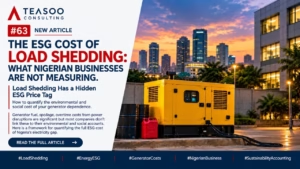
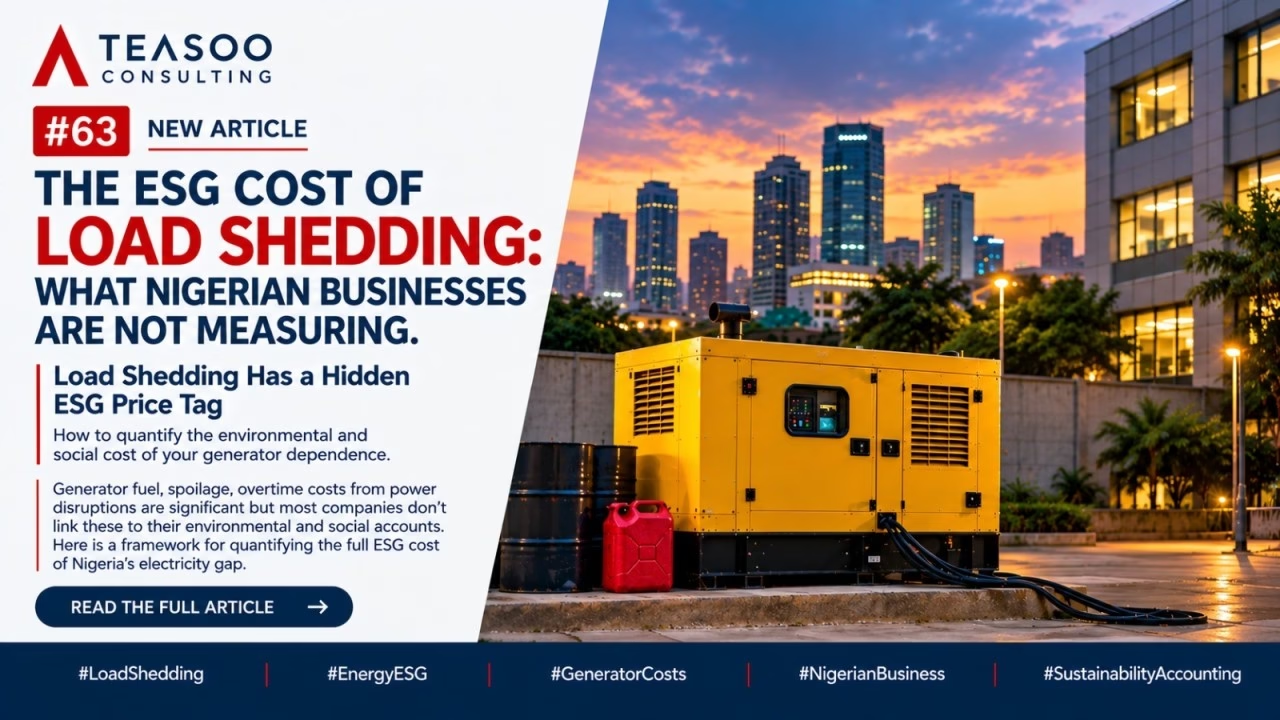
Load Shedding: The Hidden Tax on Nigerian Business
For many Nigerian businesses, load shedding is not a background inconvenience. It is a recurring operational crisis.
Scheduled and unscheduled outages can run for six to twenty hours a day in many parts of the country. A cold chain breaks. A production run is lost. A data centre goes offline. Customer-facing services go dark. Each outage carries a direct cost in diesel, a cost in lost output, and a cost in wear on backup equipment. Across millions of businesses, that adds up to an estimated several billion dollars in annual losses to the Nigerian economy.
The burden falls unevenly. Large corporations absorb it through scale. Small and medium enterprises, which form the backbone of Nigeria’s economy, absorb it through margin compression, reduced hours, or simply closing. Informal businesses, where women are disproportionately concentrated, often have no backup at all.
Load shedding is therefore not just an infrastructure problem. It is an ESG problem. It suppresses productivity, concentrates cost on the most vulnerable businesses, and makes credible ESG performance harder to achieve and measure. A company that cannot guarantee uptime cannot optimise efficiency. A company running on emergency diesel around the clock is not on a credible emissions reduction pathway.
Solar Has Become a Commercial Decision, Not a Climate One
The question for most businesses is no longer “Can we afford solar?” It is “Can we afford not to?”
Commercial solar typically pays back within a few years through reduced diesel and grid spend, after which it delivers materially cheaper power for the rest of its operating life. Beyond the bill: better cost predictability, less exposure to fuel-price swings, lower maintenance, stronger business continuity.
For anything depending on refrigeration, production equipment, telecoms, or uninterrupted service, energy reliability is commercial value: an environmental win, a governance win, and a social win in one investment.
The Transition Runs on Data It Does Not Have
Nigeria’s ETP depends on credible data on consumption, emissions, infrastructure, and investment. What exists is fragmented, inconsistent, and thin on institutional data-sharing.
That is not a technical gap. It is a governance one. Without harmonised data, policymakers cannot measure progress, investors cannot price risk, and businesses cannot set credible baselines.
The same is true for corporate ESG reporting: a company cannot demonstrate sustainability performance it has not actually measured. Good ESG starts with good information.
Disclosure Is Becoming a Capital Issue
IFRS S1/S2 and Nigerian Exchange ESG requirements are raising the bar on what counts as credible disclosure. The direction is clear: less voluntary storytelling, more structured accountability.
But compliance is not the same as quality. Recent assessments of Nigerian listed companies show formal disclosure does not always mean robust materiality assessment or strong governance behind it. As Nigerian businesses chase international capital, investors will keep pressing on that gap.
Inclusion Is Not Automatic
Nigeria’s informal sector is a huge share of economic activity, and women are disproportionately concentrated in it, often in the least protected work.
New technology does not distribute its benefits by default. Solar installation, e-mobility, clean cooking, and climate-smart enterprise all create opportunity, but without deliberate design around finance, skills, infrastructure, and market access, that opportunity bypasses exactly the people who need it most.
The Real Opportunity
The goal is not just solar panels replacing generators. It is an economy that is more energy secure, more productive, more transparent, more resilient, and more inclusive, for informal businesses and communities, not just large corporations.
The government sets the policy and data infrastructure. Businesses invest in efficiency, renewables, and credible ESG systems. Financial institutions design capital for smaller, underserved players. And ESG professionals connect all of it (energy, governance, social impact, financial performance) into one coherent strategy, not a reporting afterthought.
Nigeria’s transition will ultimately be judged less by tonnes of carbon avoided, and more by whether businesses got more resilient, capital got more responsible, and ordinary Nigerians got to participate.
At Teasoo Consulting, we help governments, organisations, and project developers connect strategy, data, governance, and implementation, turning ESG and climate commitments into measurable outcomes.
What is the biggest barrier to a credible energy transition in your sector: cost, data, or access? Drop your take below.
#LoadShedding #EnergyESG #GeneratorCosts #NigerianBusiness #SustainabilityAccounting