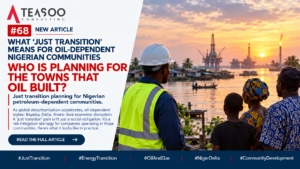
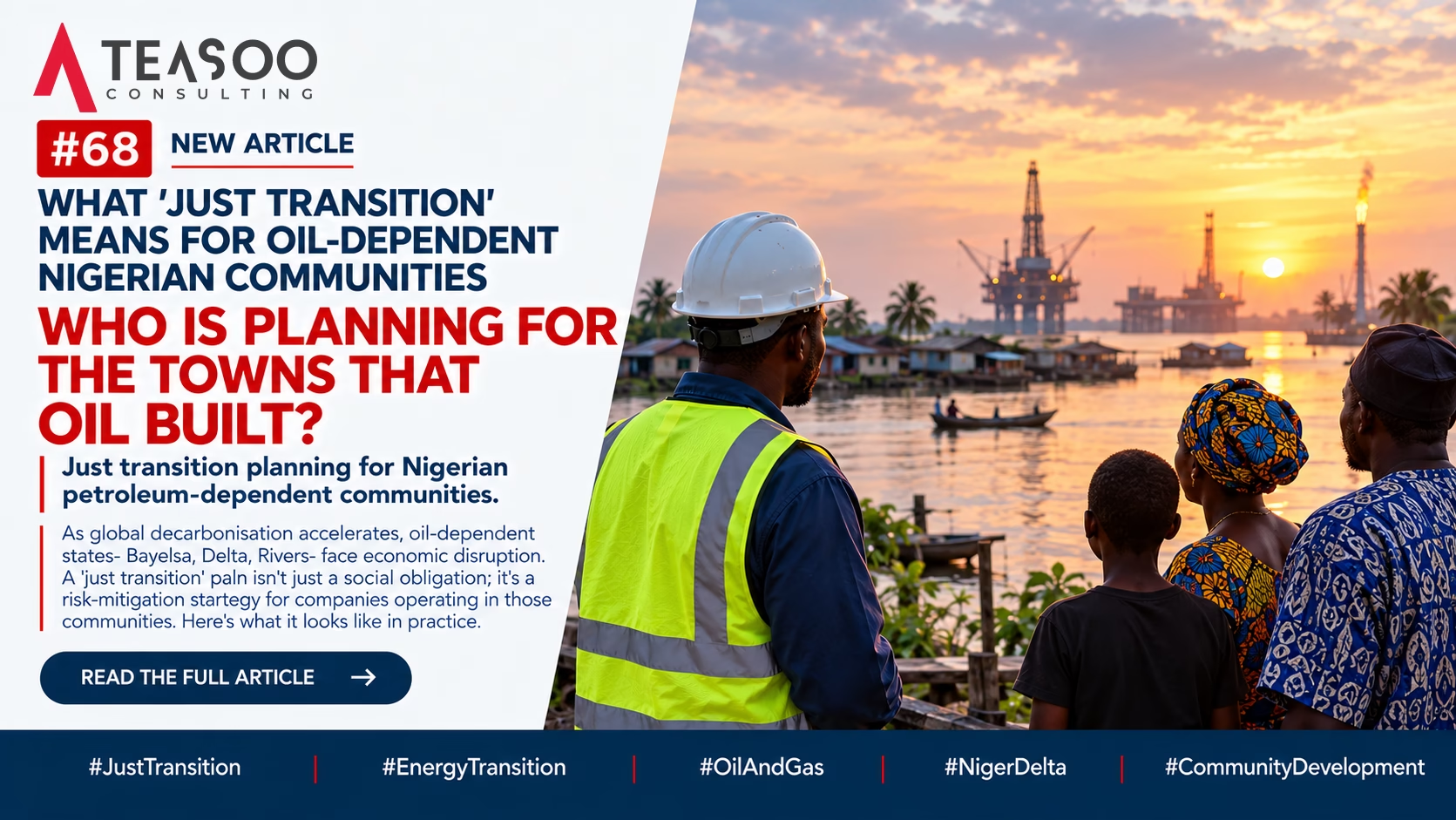
As global capital pivots aggressively toward renewable energy and net-zero targets, the conversation around the “Energy Transition” often focuses on carbon credits, solar grids, and EV adoption. But zoom in on the Niger Delta—states like Rivers, Bayelsa, and Delta—and a much more human crisis is brewing.
For decades, these regions have been the engine room of Nigeria’s economy. Oil has built the towns, funded the local economies, and provided direct and indirect employment for millions. As decarbonisation accelerates and international oil companies (IOCs) divest or scale down onshore operations, a critical question emerges: What happens to the communities left behind?
A “Just Transition” ensures that the shift to a low-carbon economy does not leave marginalized communities economically stranded. For energy firms operating in Nigeria, implementing a Just Transition plan is no longer just a Corporate Social Responsibility (CSR) checkbox. It is a critical risk-mitigation strategy to prevent social unrest, protect assets, and secure a lasting Social License to Operate (SLO).
Here is what a Just Transition looks like in practice for Nigerian petroleum-dependent communities:
1. Shifting from Philanthropy to Economic Diversification
The traditional CSR model of building a community hall or a localized health center is insufficient for the transition era. Companies must now focus on catalyzing entirely new micro-economies that can survive without oil.
- In Practice: This means directing Host Community Development Trust (HCDT) funds—as mandated by the Petroleum Industry Act (PIA)—into sustainable sectors like modernised agribusiness, aquaculture, and local manufacturing. The goal is to build an ecosystem where local businesses supply the broader Nigerian market, not just the local oil rig.
2. Reskilling for the Green and Tech Economies
The technical skills prevalent in the Niger Delta—welding, pipeline maintenance, heavy machinery operation—are highly transferable.
- In Practice: A Just Transition involves proactively funding training programs that pivot these skills toward the future. A pipeline welder can be trained in solar panel mounting and mini-grid infrastructure. Investing in local tech hubs and digital literacy ensures the youth are integrated into the global digital economy, rather than being left waiting for oil jobs that are slowly disappearing.
3. Turning Environmental Remediation into an Industry
Decades of extraction have taken a heavy toll on the Niger Delta’s ecosystem. As companies transition or divest, environmental remediation cannot simply be contracted out to foreign firms.
- In Practice: Clean-up and land restoration efforts must be designed as massive local job creators. By training and employing local community members in environmental science, mangrove restoration, and soil remediation, companies can turn a legacy of pollution into an economic bridge to the future.
4. Collaborative and Transparent Planning
A transition cannot be forced on a community; it must be designed with them. When communities feel abandoned by shifting corporate priorities, the risk of asset vandalism and operational disruption skyrockets.
- In Practice: Honest communication about the lifespan of oil assets is crucial. Companies must engage local traditional leaders, women’s groups, and youth councils in long-term scenario planning. When communities co-own the transition roadmap, they become partners in the process rather than adversaries.
Securing Your Legacy
The energy transition is inevitable, but a chaotic socio-economic fallout in the Niger Delta is not. Energy companies that proactively design Just Transition frameworks will not only protect their operational stability today but will also cement a legacy of responsible corporate citizenship for decades to come.
At Teasoo Consulting, we help organizations navigate the complex intersection of ESG commitments and local community realities. We partner with energy firms to design, implement, and monitor Just Transition strategies that protect both your business interests and the communities that host you.
Is your organization prepared for the socio-economic impacts of the energy transition? Let’s talk about building your Just Transition roadmap.
#JustTransition #EnergyTransition #OilAndGas #NigerDelta #CommunityDevelopment