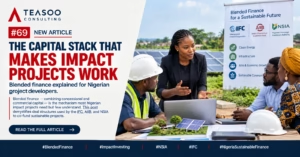
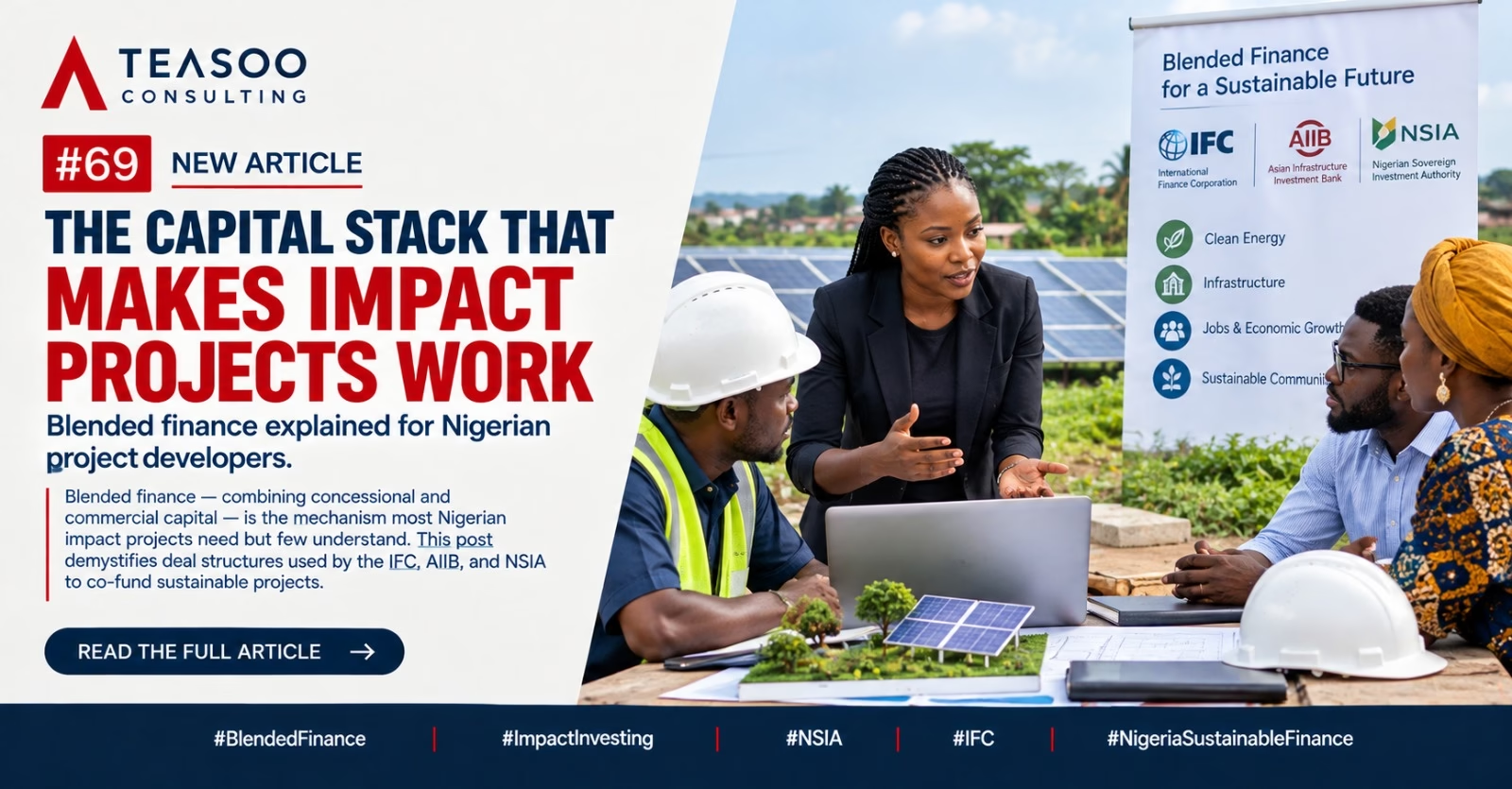
The Capital Stack That Makes Impact Projects Work
Many Nigerian impact projects have a strong development case and still cannot raise capital. A community reforestation scheme, for example, may take years to earn revenue, depend on income that is hard to forecast, and offer lenders little collateral. Commercial banks, which lend at high naira interest rates and often for short tenors, rarely fund such projects alone. Blended finance is one way to close that gap.
What it is, and what it is not
Blended finance uses concessional capital, such as grants, below-market loans or guarantees, to reduce a project’s cost or risk so that commercial investors will participate. Concessional money is a tool, not the goal. It should be as small as the project needs and should mobilise much larger private flows. It is not free money, and it cannot rescue a weak business case.
Reading the capital stack
A blended deal is easiest to understand as layers of financing, each suited to a different appetite for risk and return:
- Grants and technical assistance fund feasibility studies, environmental assessments and project preparation.
- First-loss or junior capital absorbs the initial losses, protecting the layers above it.
- Mezzanine or subordinated debt ranks behind senior lenders and earns a higher return for taking more risk.
- Senior debt from banks and institutional investors carries the lowest risk and the lowest return.
- Guarantees are not a layer. They transfer specified risks to a third party and improve a borrower’s credit.
Because the concessional layers absorb losses first or cover specific risks, senior lenders see a safer investment and can offer better terms or longer tenors.
How the institutions apply it
The International Finance Corporation (IFC) uses several tools. In an A/B loan, IFC lends from its own account and arranges a parallel loan from commercial banks, which benefit from IFC’s preferred creditor status. IFC also administers blended concessional facilities that can improve affordability or share the risk of first-of-a-kind projects. Terms vary by programme.
The Asian Infrastructure Investment Bank (AIIB) finances infrastructure alongside governments, commercial lenders and other multilateral banks. Its main contribution is often long-tenor debt, which local banks seldom provide. Not every AIIB transaction is blended finance, but its co-financing approach shows how development lenders can support commercially sound infrastructure.
The Nigeria Sovereign Investment Authority (NSIA) plays a domestic role, connecting public investment objectives with private participation. It was among the institutions behind InfraCredit, whose local-currency guarantees help infrastructure bonds attract pension fund investors. Not every NSIA investment is blended finance, since that depends on how each transaction is funded.
The Nigerian realities
Three issues shape almost every deal here:
- Currency mismatch. Naira revenues against dollar-denominated debt is one of the largest risks in Nigerian project finance. Local-currency guarantees, hedging, or revenues indexed to the debt currency can reduce it.
- Local capital. Pension funds hold large naira assets and need long-dated, high-quality investments. Credit-enhanced instruments are one route to unlocking them.
- Impact standards. Development lenders expect measurable outcomes and compliance with environmental and social standards, such as the IFC Performance Standards.
What developers should do
- Build the business case first, including realistic revenue assumptions, an identifiable market and a capable team.
- Name the risks that stop investors, such as early-stage costs, limited collateral, uncertain demand or currency exposure.
- Match each risk to an instrument: grants for preparation, guarantees for specific losses, concessional debt for tenor and cost, and equity for business risk.
- Show additionality. Explain why the project cannot proceed without concessional support and what changes once it is in place.
- Engage early. Approach development finance institutions during project design, not after it.
The takeaway
Blended finance works when each investor takes the risk they are best placed to carry. It rewards developers who prepare thoroughly, structure deliberately and measure their results. For sectors such as reforestation, decentralised energy and sustainable agriculture, that discipline can turn socially valuable projects into investable ones.
Which financing barrier has held back a project you have worked on? Share your experience in the comments.
#BlendedFinance #ImpactInvesting #NSIA #IFC #NigeriaSustainableFinance