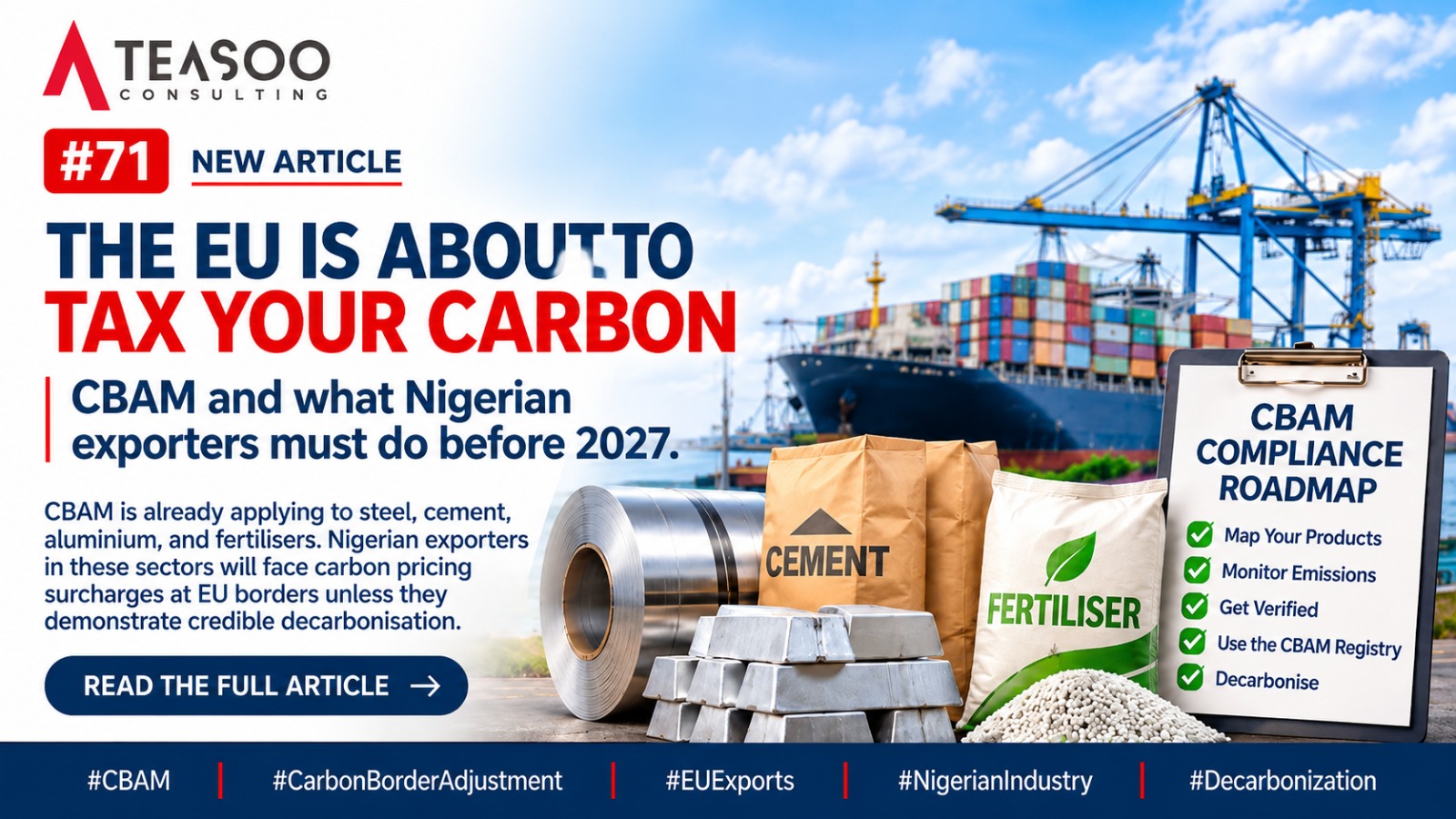
In short: CBAM covers iron and steel, aluminium, cement, fertilisers, electricity and hydrogen. EU importers now pay for the carbon in these goods, and they will ask you for emissions data. The first declaration is due by 30 September 2027, but imports since 1 January 2026 already count.
Imagine a German buyer emails you: “Please send the verified emissions data for your aluminium plant.” If you can’t, they will use EU default values, and they will pay more. Some buyers may look for another supplier.
This is now a reality for Nigerian manufacturers who export to Europe.
What Is CBAM?
CBAM ensures that imported carbon-intensive goods face a carbon cost comparable to products made in the EU. Its aim is to prevent carbon leakage, where production shifts to countries with weaker climate policies.
It covers six sectors: iron and steel, aluminium, cement, fertilisers, electricity and hydrogen. Coverage is product-specific, so check your customs codes rather than assuming an entire industry is in or out.
What Changed in 2026?
From October 2023 to December 2025, EU importers only reported emissions. Since 1 January 2026, they must also be authorised, report emissions and surrender certificates. The first declaration, covering 2026 imports, is due by 30 September 2027.
The legal obligation sits with the EU importer, not the Nigerian exporter. But the commercial impact reaches you, because buyers need your data to calculate embedded emissions.
Why Your Data Matters: The Default Value Problem
Without verified actual emissions data, importers must use EU default values, which carry mark-ups. For cement, iron and steel, aluminium and hydrogen, the mark-up is 10% in 2026, 20% in 2027 and 30% from 2028 onwards. For fertilisers, it is 1% throughout.
These mark-ups apply to the default emissions values, not to the selling price. Still, higher declared emissions mean a higher certificate bill for your buyer. A Nigerian aluminium producer who can show verified, lower actual emissions gives its German customer a clear reason to keep buying.
What Could It Cost?
Certificate prices track EU ETS allowance prices, calculated quarterly in 2026 and weekly from 2027. The Commission published €82.32 per tonne of CO₂ for Q3 2026, as an illustration. The real obligation depends on the product, its embedded emissions and any eligible carbon price already paid at origin. Importers pay, but these costs will shape supplier negotiations.
Five Steps to Prepare
1. Map your products. Check your export catalogue against Annex I of Regulation (EU) 2023/956 and its CN codes. Not every steel or aluminium product is covered.
2. Set up emissions monitoring. CBAM needs product-specific embedded emissions, not a general corporate footprint. Track direct emissions, indirect emissions from electricity where applicable, precursor materials and production volumes at installation level.
3. Get independent verification. Where actual values are used, an accredited verifier must confirm them. Keep production records, energy bills, fuel data and material inputs. Talk to your European buyers early.
4. Prepare for the CBAM Registry. Non-EU operators can register through the Operators of Third Countries Installations (O3CI) portal, so importers can retrieve your installation data. Agree with your buyers who will provide, verify and share it.
5. Build a decarbonisation plan. Improve energy efficiency, cut fuel use, optimise processes, reduce waste and explore lower-carbon energy and inputs. A carbon price actually paid in Nigeria may also be deductible under Article 9, but only with evidence. Carbon credits and voluntary projects don’t automatically qualify.
CBAM Is a Business Issue
Market access will increasingly depend on proving how products are made, not just on quality, price and delivery. Companies that start measuring and improving now will be better placed. Better energy management also cuts costs and strengthens competitiveness.
At Teasoo Consulting, we combine environmental assessment, emissions measurement, data management and practical decarbonisation planning to help manufacturers get ready.
The question is no longer whether carbon performance will influence trade. It is whether you’ll be ready when European buyers ask for the evidence.
The carbon footprint of your product is becoming part of its price. Is your business prepared to demonstrate it?