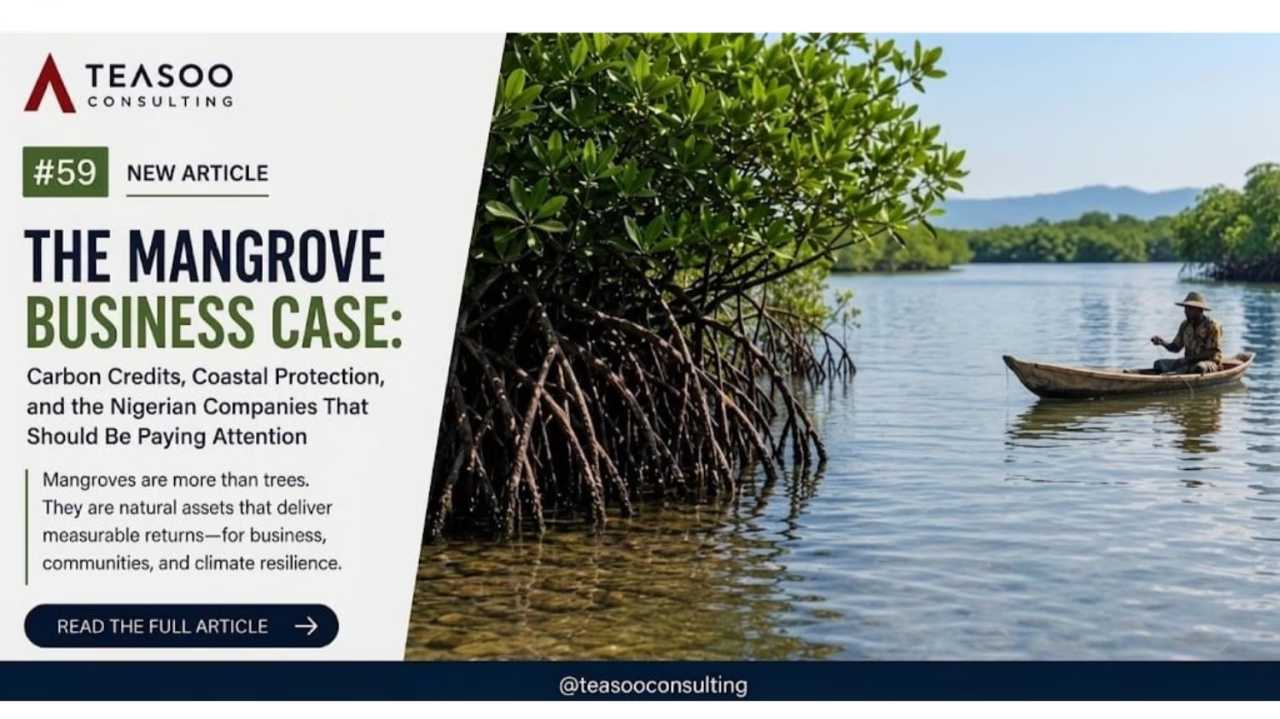
For coastal Nigerian businesses, mangrove restoration is no longer simply a conservation initiative. It is a practical business strategy: one that can protect assets, strengthen supply chains, create carbon-credit opportunities and demonstrate credible ESG leadership.
Nigeria’s mangrove forests are among the country’s most valuable natural assets. Covering approximately 10,500 km², they represent the largest mangrove area in Africa and the third largest in the world. These ecosystems support biodiversity, filter coastal pollution, provide nursery habitat for fisheries and form a natural first line of defence against erosion, flooding and storm surges.
Yet they are being lost where they are needed most.
A national resource concentrated in high-risk coastal states
Nigeria’s mangroves are concentrated in three states. Bayelsa holds approximately 41% of the national resource, while Delta and Rivers each account for about 25%. Together, these three states contain more than 90% of Nigeria’s mangrove forests.
That concentration makes the Niger Delta central to Nigeria’s blue-carbon opportunity, and also to its risk. Between 1996 and 2016, Bayelsa lost an estimated 8,274 hectares of mangrove forest, representing 49% of recorded national loss in that period. Delta lost about 4,824 hectares, while Rivers lost 2,281 hectares.
The challenge extends beyond the largest mangrove states. Ondo recorded the country’s highest proportional rate of mangrove loss, at 42.31%, followed by Lagos at 6.11%. Oil pollution, urbanisation, wood harvesting and invasive species are driving widespread degradation across Nigeria’s coast.
Mangroves are a balance-sheet issue
Mangroves capture and store significant amounts of carbon, with estimates showing they can sequester carbon several times faster than tropical forests. Their dense root systems also stabilise shorelines and dissipate wave energy before it reaches roads, jetties, terminals, warehouses and communities.
Shoreline studies at Bonny Island illustrate the scale of exposure in coastal areas where dredging, sand filling, energy infrastructure, sea-level rise and storm surges interact. A geospatial assessment of the island’s Finima section recorded a net land loss of 458 hectares (roughly 4.6 km²) over a 35-year period from 1976 to 2011, with erosion outpacing accretion. Separate studies have measured shoreline erosion rates of 20 to 35 metres a year along parts of the island.
For ports, industrial facilities and coastal communities, erosion is not an abstract environmental concern. It can mean higher maintenance costs, operational disruption, damaged access routes, escalating insurance exposure and more capital-intensive coastal defences.
A restored mangrove belt will not replace sound engineering or responsible project design. But it can reduce pressure on hard infrastructure and, in many cases, deliver shoreline stabilisation and wave attenuation more cost-effectively than seawalls alone.
That makes mangrove restoration a form of risk management, with the added potential to generate high-quality blue-carbon credits.
Why mangroves, and not other trees?
The comparison is often made to terrestrial reforestation, but mangroves work differently in ways that matter for both climate and business.
Most of a mangrove’s carbon sits in the soil beneath it, not in its trunk and branches. Waterlogged, low-oxygen mangrove soils slow decomposition dramatically, so plant matter accumulates as stored carbon over centuries rather than decades. This is the basis of “blue carbon”: mangroves can sequester carbon several times faster than tropical rainforest, and store it far more durably.
Their tangled, above-ground root systems also do something upland trees cannot: they physically dissipate wave energy and slow tidal surges before they reach the shore, in effect a living seawall. Combined with their position at the boundary between land and sea, mangroves double as nurseries for commercially important fish and shellfish, and as natural filters for land-based pollution before it reaches open water.
This combination of durable carbon storage, coastal defence and ecosystem services is why mangrove credits attract a market premium over standard forestry credits, and why they sit under their own dedicated carbon methodology (Verra’s VM0047), built specifically for tidal, saline wetland conditions rather than adapted from a generic reforestation model.
Why blue carbon is becoming commercially relevant
Blue carbon refers to carbon captured and stored by coastal ecosystems, particularly mangroves, seagrass beds and salt marshes. Mangroves are especially attractive because they combine high carbon-storage potential with measurable benefits for biodiversity, fisheries and coastal resilience.
The commercial opportunity is expanding quickly. The global blue-carbon market was valued at approximately USD 1.0 billion in 2025 and is projected to reach USD 1.2 billion in 2026, growing to USD 10.3 billion by 2036, a projected compound annual growth rate of 24%, according to market analysis published in March 2026.
Mangroves are expected to lead this market. They are projected to account for approximately 57% of the blue-carbon ecosystem market, reflecting their exceptional carbon-stock density. Carbon-offset and credit procurement is expected to remain the largest use case, representing around 62% of market activity.
For Nigerian businesses, this matters because blue-carbon credits can command a meaningful price premium. Market pricing for mangrove-linked blue-carbon credits has generally ranged from roughly USD 15 to USD 25 per tonne of CO2e, with benchmark prices briefly touching a record USD 29.30 per tonne in August 2025 amid tight supply. This compares with roughly USD 5 to USD 8 per tonne for many standard terrestrial forestry offsets, though pricing across both markets varies considerably by project type and quality.
That premium reflects more than carbon storage. Buyers increasingly value the additional benefits that mangrove projects can deliver: stronger coastal resilience, biodiversity protection, improved fisheries and tangible livelihood benefits for local communities.
Companies therefore have two distinct opportunities:
- Use credits as part of a credible climate strategy. Companies can support restoration to address residual emissions after prioritising direct emissions reductions.
- Develop or co-finance credit-generating projects. Carbon revenues can help fund long-term restoration, monitoring, community stewardship and coastal protection.
Nigeria’s policy environment is also moving in this direction. The Carbon Market Activation Policy, introduced in 2025, provides a roadmap for high-integrity carbon investment and Article 6 participation. In March 2026, Nigeria issued its first Article 6 Letter of Authorisation, to clean-cooking company BURN, enabling international transfer of carbon credits under the Paris Agreement framework. No Nigerian blue-carbon project has yet received this type of authorisation, but the step signals that the country is beginning to operationalise international carbon-market participation more broadly, an infrastructure that future mangrove projects could draw on.
For corporate leaders, the message is clear: the market is moving from concept to infrastructure. Early movers can help establish projects with strong environmental integrity and meaningful local benefits.
The financing playbook
A commercially sound mangrove-restoration programme should be designed as a long-term asset-protection and carbon-finance initiative, not a one-off tree-planting campaign.
- Start with physical-risk exposure
- Identify operations exposed to erosion, flooding and storm surges
- Prioritise assets near degraded estuaries, creeks, port approaches, industrial corridors and fishing communities
- Assess shoreline change, flood exposure, asset value at risk and current spend on maintenance or coastal defences
- Compare: cost of inaction vs. cost of grey infrastructure vs. how much restoration can reduce total risk
- Restore ecosystems, not just seedlings
- Start with hydrology, tidal flows, land-use pressures, pollution sources and community access rights, not the planting itself
- Often, restoring water flow and halting continued degradation matters more than adding trees
- Build in multi-year maintenance, survival monitoring and transparent reporting
- Success is a functioning, protected ecosystem, not a tree count
- Partner with communities from the outset
- Mangroves support fisheries, fuelwood livelihoods and local food systems
- Excluding communities risks conflict, low seedling survival and reputational damage
- Set up transparent benefit-sharing: paid restoration work, community monitoring, support for sustainable fisheries or alternative livelihoods, and a share of carbon-credit income
- Blend funding sources
- Don’t rely on CSR budgets alone
- Combine corporate ESG/resilience capital, port or industrial-infrastructure budgets, carbon-credit pre-purchase agreements, development-finance grants, insurance partnerships and public-private collaboration
- Use upfront corporate investment to establish the ecosystem, then let carbon revenues fund long-term stewardship
- Protect carbon integrity
- Work with experienced project developers, independent technical advisers and recognised monitoring frameworks
- Get land tenure, baselines, carbon accounting, protection commitments and credit ownership right and documented
- Understand Nigeria’s Article 6 rules if credits will be transferred internationally, to avoid double counting
Who should act first?
The immediate business case is strongest for companies whose operations depend on stable coasts and healthy marine ecosystems:
- Ports, terminals and logistics operators protecting access routes and waterfront assets
- Oil, gas and energy companies with Niger Delta infrastructure
- Fisheries, seafood processors and aquaculture operators dependent on mangrove nursery habitats
- Banks and insurers financing coastal assets
- Tourism and hospitality businesses around lagoons, estuaries and beaches
- Manufacturers and industrial parks exposed to flooding, drainage and supply-chain disruption
For these businesses, the question is not whether mangroves have value. It is whether that value will be recognised early enough to protect operations and create competitive advantage.
From ESG statement to business strategy
Nigeria’s mangroves sit at the intersection of climate action, biodiversity, food security, coastal resilience and the blue economy. Their degradation creates real costs for companies and communities. Their restoration offers a way to address several business challenges at once.
The most effective corporate programmes will not treat mangroves as an offsetting exercise or a public-relations campaign. They will treat them as natural infrastructure: assets that lower risk, support livelihoods, strengthen licence to operate and may generate premium carbon revenues.
For coastal Nigerian companies, funding mangrove restoration is increasingly a decision about resilience, not charity.
#MangroveRestoration #BlueCarbonNigeria #CarbonCredits #CoastalResilience #NatureBasedSolutions