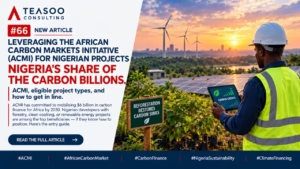
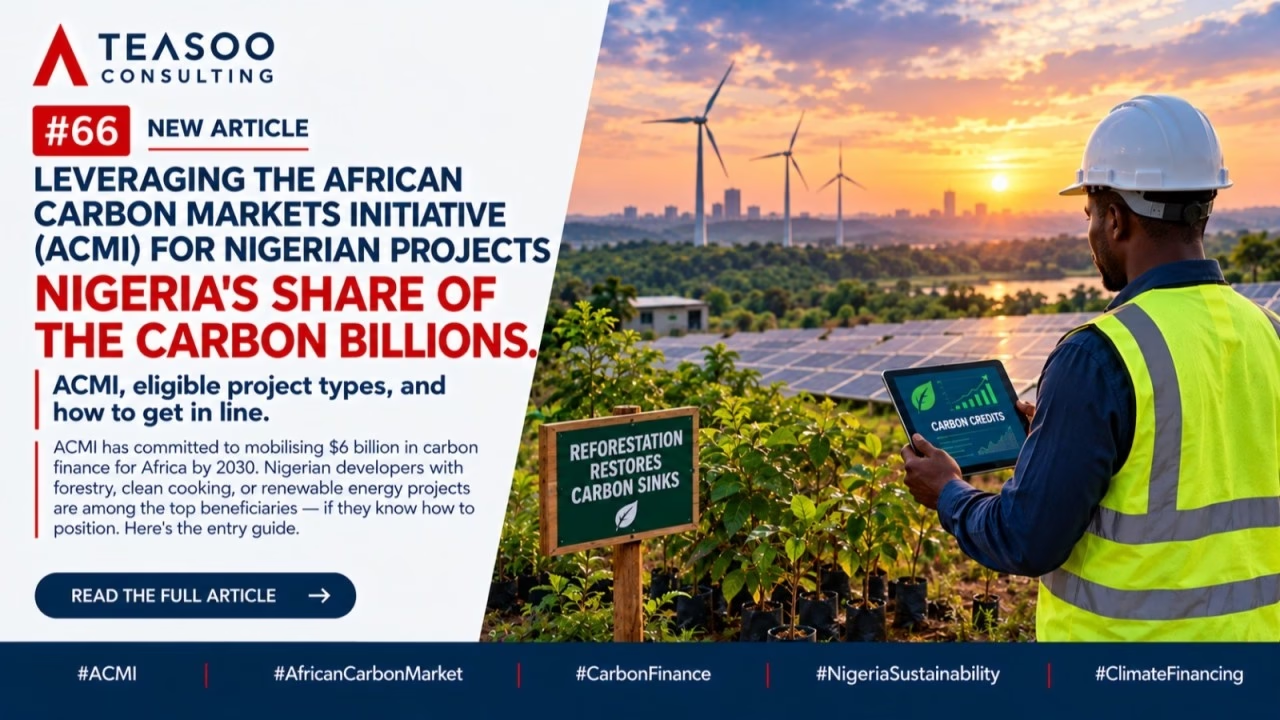
Nigeria’s carbon market is entering a new phase, creating opportunities for project developers working in areas such as forestry, clean cooking, renewable energy and other low-carbon solutions.
At the same time, the Africa Carbon Markets Initiative (ACMI) is helping to strengthen the continent’s carbon-market ecosystem by connecting African projects with buyers, investors, knowledge and market-building initiatives.
For Nigerian developers, the opportunity is not simply to generate carbon credits. Projects need to meet Nigerian regulatory requirements, demonstrate environmental and social integrity, and be positioned to attract credible buyers and investors.
So, how can Nigerian projects make use of the ACMI ecosystem?
What Is ACMI?
The Africa Carbon Markets Initiative (ACMI) is an African-led initiative launched at COP27, the 2022 United Nations Climate Change Conference held in Sharm el-Sheikh, Egypt, to help scale high-integrity carbon markets across the continent.
Its original ambition was to help Africa reach 300 million carbon credits annually by 2030 and more than 1.5 billion annually by 2050, while mobilising investment, creating jobs and supporting climate and development outcomes.
In simple terms, carbon credits are generated by projects that reduce or remove greenhouse gas emissions, such as restoring forests, expanding clean cooking or replacing fossil-fuel-based energy with renewable alternatives.
ACMI’s role is to help strengthen the ecosystem around those projects, including market access, project development, demand, investment, knowledge and integrity.
What Does ACMI Offer?
ACMI is not a conventional project-finance fund that developers apply to for a grant. Instead, it provides market-building platforms, resources and connections that can help projects become more visible and investment-ready.
For project developers, this includes:
- Visibility: The African Carbon Credit Showcase provides a central platform for presenting African carbon projects to potential buyers and investors.
- Market demand: ACMI’s Advance Market Signal aggregates declarations of intent from buyers interested in purchasing African carbon credits.
- Project development support: The Africa Carbon Hub provides guidance, tools, case studies and resources for developers navigating the carbon market.
- Market development: ACMI works with governments and market participants to strengthen carbon-market frameworks and develop approaches suited to African projects.
- Integrity and transparency: ACMI promotes high-integrity carbon markets, including stronger disclosure around project benefits, community participation and credit quality.
For a Nigerian project developer, the practical question is therefore not simply whether ACMI will fund the project, but how the project can become credible, visible and investment-ready within the wider African carbon-market ecosystem.
Step 1: Get the Nigerian Regulatory Foundation Right
Before approaching international buyers, developers need to understand and comply with Nigeria’s evolving carbon-market framework.
Nigeria’s Carbon Market Framework and Activation Policy establish the foundation for participation in voluntary, domestic and international carbon markets, while the National Council on Climate Change (NCCC) provides the central institutional framework for carbon-market governance.
For developers, this means:
- Understand the approval process: Determine the applicable requirements for registering and developing the project under Nigeria’s national carbon-market framework.
- Register the project: Use the National Carbon Registry and follow the applicable procedures for project and developer registration.
- Determine the market pathway: Establish whether the project is intended for the Voluntary Carbon Market, an international transaction under Article 6 of the Paris Agreement, or a future domestic compliance mechanism.
- Address authorisation requirements: Projects intended for international transfers may require host-country authorisation and, where applicable, a corresponding adjustment. The requirements depend on the transaction and the applicable Nigerian rules.
The important point is that market access begins with regulatory clarity at home. Developers should establish the project’s legal, land, environmental and regulatory position before investing heavily in international market positioning.
Step 2: Build to International Integrity Standards
Getting regulatory approval is only one part of becoming investment-ready.
Serious carbon-credit buyers increasingly want evidence that credits represent real, measurable and additional climate benefits and that projects manage environmental and social risks responsibly.
Depending on the project type, developers may consider recognised carbon-crediting standards such as Verra’s Verified Carbon Standard (VCS) or the Gold Standard, alongside relevant social and biodiversity standards.
Key considerations include:
- Additionality: Demonstrate that the project would not have occurred in the same form without carbon-market revenue or other qualifying interventions.
- MRV: Establish credible monitoring, reporting and verification systems.
- Community engagement: Clearly document stakeholder consultation, consent processes and benefit-sharing arrangements.
- Land and resource rights: Establish clear rights to the project area and the carbon benefits associated with it.
- Environmental and social safeguards: Identify and manage potential impacts on communities, workers and ecosystems.
- Project-specific methodology: Select a methodology that appropriately reflects the project’s activities, baseline and emissions-reduction or removal pathway.
For forestry projects, this may include land tenure, community participation, biodiversity and permanence considerations.
For clean-cooking projects, it may include robust baseline assumptions, usage monitoring and credible evidence of emissions reductions.
For renewable-energy projects, eligibility will depend on the applicable methodology, baseline, additionality and other regulatory and methodological requirements.
The goal is not simply to produce credits. It is to produce credits that buyers can trust.
Step 3: Use ACMI to Improve Market Visibility and Access
Once a project has a credible development and certification pathway, ACMI can become useful as part of the project’s broader market strategy.
Developers can:
- Explore the African Carbon Credit Showcase to understand how projects are presented to the market and whether their project may be eligible for inclusion.
- Monitor ACMI’s Advance Market Signal to understand areas of buyer interest and emerging demand.
- Use the Africa Carbon Hub for carbon-market guidance, project-development resources and sector-specific tools.
- Build relationships with buyers and investors who are actively looking for high-integrity African projects.
- Use market signals to shape project design, particularly around the types of credits, co-benefits and geographies attracting demand.
ACMI has reported more than US$1 billion in aggregated intentions to purchase African carbon credits by 2030, alongside US$250 million in signalled investment intentions for high-integrity African carbon projects.
These figures are important market signals, but they should not be interpreted as guaranteed financing for individual projects. Developers still need to demonstrate project quality, commercial viability, carbon-credit potential and the ability to deliver.
Step 4: Explore Nigeria’s Green Investment Incentives
Nigeria’s carbon-market framework also recognises the importance of fiscal incentives in attracting investment into carbon-reduction projects.
The framework proposes measures including:
- VAT and tax exemptions on carbon credits and income generated from their sale for a specified period, subject to the applicable requirements and implementation measures.
- Accelerated capital allowances for qualifying assets associated with carbon-reduction projects.
- Capital allowances and deductions for qualifying research and development expenditure related to carbon-reduction projects and technologies.
Developers should treat these as part of the project’s financial planning rather than assuming that every project automatically qualifies for every incentive.
The applicable tax treatment, eligibility criteria and implementation rules should be confirmed before financial close.
The Bottom Line
For Nigerian carbon-project developers, the pathway is becoming clearer:
- Establish the Nigerian regulatory foundation.
- Build the project around credible methodologies and strong integrity safeguards.
- Use ACMI’s platforms, market signals and resources to improve visibility and access to buyers and investors.
- Explore the fiscal incentives available to qualifying projects and investments.
The strongest projects will be those that combine credible emissions reductions or removals with strong community engagement, transparent benefit-sharing, sound financial structures and rigorous monitoring and verification.
Nigeria’s carbon market is still developing, but the direction is clear. Projects that are well-structured, transparent and able to demonstrate real climate and development benefits will be better positioned to attract serious market interest.
For developers, the opportunity is to prepare now.
How Teasoo Can Help
Navigating carbon-market requirements, international standards and potential financing channels requires more than technical carbon expertise. It requires a clear understanding of project development, stakeholder engagement, ESG risks, regulatory requirements and commercial structuring.
At Teasoo Consulting Ltd., we are a strategic advisory and delivery firm working across infrastructure, the public sector, ESG and international development.
We work alongside project developers, communities and institutions to turn sustainability ambitions into well-structured, credible and delivery-ready projects.
If you are exploring carbon finance in Nigeria, let’s talk.
Are you developing a carbon project in Nigeria? Share your experience in the comments.
#ACMI #AfricanCarbonMarket #CarbonFinance #NigeriaSustainability #ClimateFinance #CarbonMarkets