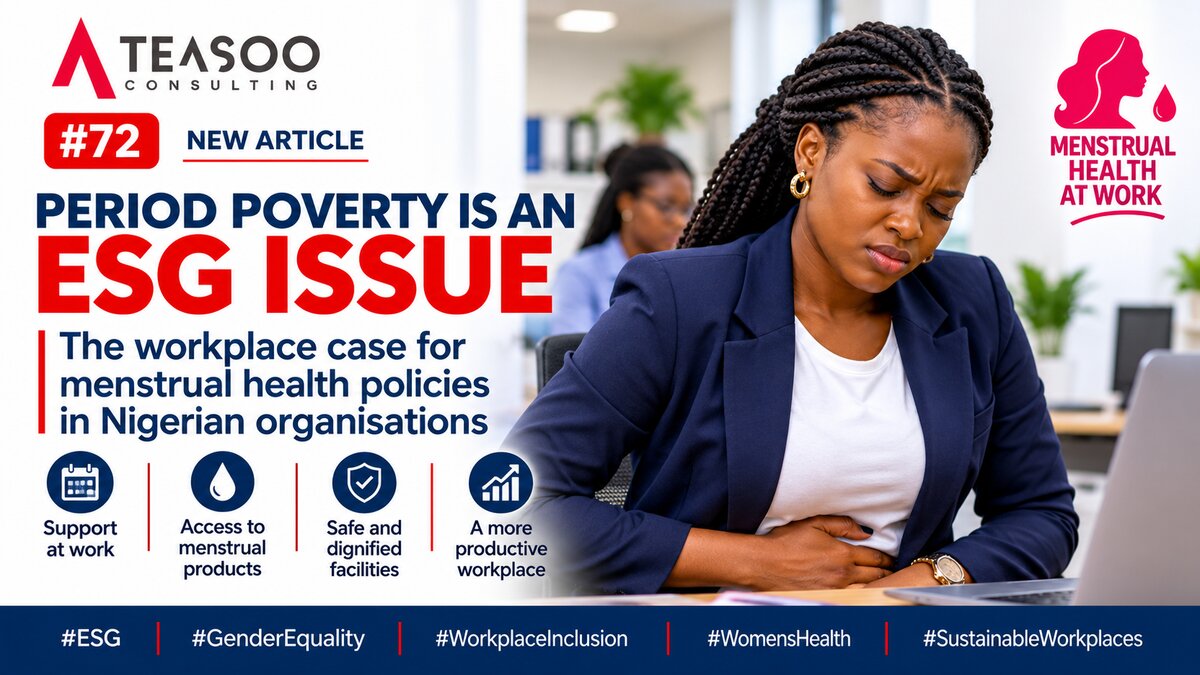
The workplace case for menstrual health policies in Nigerian organisations
The cost that never makes the balance sheet
Every month, Nigerian businesses may be losing productivity in ways they rarely measure.
It can show up in absenteeism, reduced concentration, discomfort at work and, in some cases, the loss of talented employees who do not feel adequately supported. It does not always appear as a line item in a company’s financial report. Sometimes, it is simply dismissed as an unproductive day or an unexplained absence.
One contributing factor is something many boardrooms still treat as too awkward to discuss: menstruation.
A Tuesday morning you already know
Picture her. She is good at her job. She is on time, even after the Lagos traffic, the Port Harcourt rain or the long Abuja commute.
It is day two of her period. The cramps arrive mid-morning. The office toilet has no running water, no sanitary disposal bin and a lock that does not hold. She did not plan for this because planning costs money, and the price of menstrual products can make them difficult to afford.
So she does what many women do. She sits through it. She smiles in the meeting. She says nothing because nobody has made it safe to speak.
By afternoon, her focus is gone. Over time, experiences like this can affect how supported she feels at work and whether she sees a future with the organisation.
That is not just a women’s issue. That is a performance problem with a solution.
Why this belongs in ESG
We talk about the “S” in ESG as if it were soft. It is not. Social risk is operational risk.
When inadequate sanitation, limited access to menstrual products and stigma around menstruation affect female workers, organisations may experience the consequences through:
- Lost productivity, from days missed and hours spent distracted or working in discomfort.
- Higher attrition, as employees seek workplaces where their needs and wellbeing are better supported.
- Weaker workplace culture, where silence and shame replace trust and inclusion.
- Reputational and stakeholder exposure, as investors, development partners and clients increasingly examine how organisations address gender equality, employee wellbeing and workplace conditions.
Period poverty refers to the inability to access affordable menstrual products, appropriate sanitation facilities, reliable information and the dignity needed to manage menstruation safely.
It represents a gap between what employees need and what their workplace provides.
Gaps can be closed.
Menstrual health also connects directly to the United Nations Sustainable Development Goals, particularly:
- SDG 3: Good Health and Well-being
- SDG 5: Gender Equality
- SDG 8: Decent Work and Economic Growth
For Nigerian organisations, addressing menstrual health is an opportunity to translate these commitments into practical workplace action.
At Teasoo Consulting, this is the kind of social-performance gap we help organisations turn into practical, measurable programmes.
What a serious policy looks like
You do not need a massive budget. You need intent, a clear plan and someone accountable.
1. Hygiene facilities that work.
Provide private, clean and functional toilets with running water, soap, lockable doors and sanitary disposal bins. These are basic workplace requirements, not special privileges.
2. Flexible leave and working arrangements.
Not every woman needs menstrual-related flexibility. However, employees should know that appropriate sick leave or flexible working arrangements are available when they need them, without being pressured to disclose private health information.
3. Menstrual product provision.
Make menstrual products available on site, free of charge and in a discreet, accessible location. Organisations can assess usage and costs to develop a sustainable provision plan.
4. A culture that can say the word.
Train managers. Retire the whispers. Create an environment where employees can raise menstrual health concerns without embarrassment or discrimination. When leaders speak plainly, stigma loses some of its power.
Measure it, or it will not matter
An intention without a metric is a slogan. If menstrual health is part of your Social pillar, treat it like one.
Organisations can start by:
- Establishing a formal menstrual health and workplace hygiene policy with a named owner.
- Assigning a dedicated budget for facilities, supplies and awareness.
- Conducting periodic audits of workplace sanitation facilities.
- Monitoring the availability and uptake of menstrual products.
- Gathering confidential employee feedback on workplace support.
- Reviewing absenteeism and retention trends while protecting employee privacy.
- Including relevant progress in ESG reporting, where material and appropriate.
These indicators help organisations understand whether their policies are working, identify gaps and make improvements.
Organisations that take these steps can strengthen their social performance, build employee trust and create working environments where women are better supported to contribute and progress.
The question for leaders
No one is asking you to solve every challenge women face at work. You are being asked to remove one barrier that is predictable, recurring and fixable.
So ask yourself, honestly:
If a woman on your team had her period tomorrow morning, would your workplace help her, or would it cost her?
The answer says more about your organisation’s commitment to social sustainability than any glossy report.
Period poverty is an ESG issue. Treat it like one.
About Teasoo Consulting
Teasoo Consulting Ltd. is a strategic advisory and delivery firm working across infrastructure, the public sector, ESG and international development. We partner with organisations to turn social and sustainability commitments, including workplace policies like this one, into practical programmes with measurable results.
If you are thinking about how to integrate menstrual health into your ESG strategy, we would love to hear from you.